AI-Enhanced. Human-Driven.
Marketing in the Age of AI.
AI is changing more than how we create content. It is changing how businesses operate, communicate, and find information. For manufacturers and job shops, it is creating new opportunities to reach buyers while changing how those buyers discover, evaluate, and select suppliers.
Since 1984, The Rico Group has adapted to major technological changes, from traditional production and advertising to digital photography, websites, search engines, social media, and marketing automation. We have continually evaluated new tools and incorporated the ones that make sense for our clients and their businesses. AI is the latest evolution, and we are embracing its potential.
But while the tools have changed, our underlying approach to marketing has not. Effective marketing still starts with understanding a business, recognizing what makes it valuable to its customers, and communicating that value in ways that build trust and drive growth.
AI can accelerate research, streamline production, and help us analyze information. But technology is only as effective as the expertise guiding it. AI can generate information about manufacturing, but it cannot independently understand the nuances of your shop floor, the challenges your customers face, or the technical details that distinguish your capabilities.
Since 1984
The Difference Isn’t Whether You Use AI. It’s How You Use It.
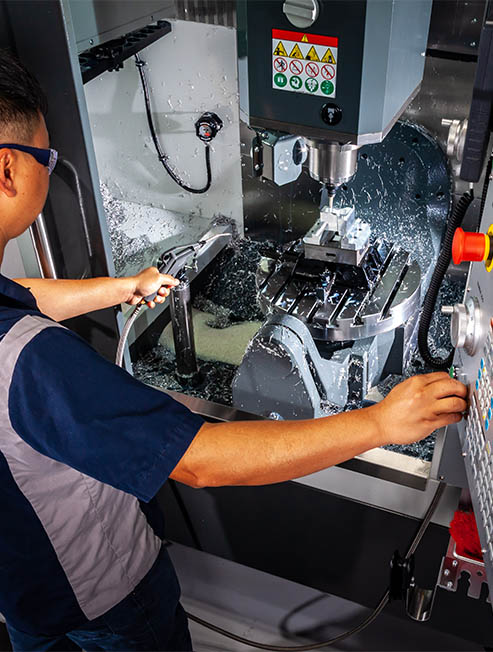
Think about a CNC machine. Many machine shops have access to the same equipment, yet their capabilities and results can vary considerably. Simply listing machines and equipment does not explain what makes one shop different from another.
A CNC machine is a tool. What matters is the knowledge, experience, and skill of the people operating it. It is their ability to understand materials, solve complex problems, work through difficult manufacturing challenges, and produce the results their customers need that creates real value.
AI is no different.
Today, businesses have access to many of the same powerful AI tools. Those tools can help generate articles, develop campaigns, analyze data, and create marketing materials. But access alone does not make someone a better marketer, writer, designer, or strategist.
The real difference comes from the experience behind the tools: knowing what questions to ask, what information matters, how to recognize an opportunity, and how to turn knowledge into something useful for the customer.
The competitive advantage isn’t the tool. It’s what you know how to do with it.
More Content Doesn’t Mean More Growth.
AI has made it easier than ever to produce articles, social media posts, emails, and other marketing materials. But when everyone has access to similar tools, producing more content is no longer a meaningful competitive advantage.
We have seen this problem in industrial marketing for years. Many manufacturing websites make similar claims about quality, service, experience, and state-of-the-art equipment. Now, AI makes it even easier to produce more of the same, often using familiar language that sounds professional but says very little about what makes a company distinctive.
The result is a crowded digital landscape filled with content that looks different on the surface but communicates much the same message.
Industrial buyers, engineers, procurement teams, and OEMs need more than another article or a list of capabilities. They need:
- relevant technical information
- practical insights
- credible solutions
- a clear understanding of how a supplier can help them solve a problem
Just as owning a CNC machine does not define a shop’s expertise, producing more content does not establish a company’s value.
The easier content becomes to create, the more important it becomes to have something meaningful to say.
Effective marketing starts with understanding what sets a business apart and communicating that difference with substance, clarity, and credibility.

AI Is Changing How Buyers Find You.
The way buyers find information is changing. The importance of being found isn’t.
Search engines are no longer the only place buyers turn when researching products, services, and technical questions. AI-powered search results, generated answers, and digital assistants are becoming part of the research process, helping people identify suppliers, understand technical subjects, and explore potential solutions.
For industrial manufacturers and job shops, this introduces a new consideration: it is not enough to focus only on where a company appears in traditional search results. Businesses also need to consider whether AI systems can discover their information, understand their expertise, and identify them as a relevant source when answering a buyer’s question.
That starts with a clear digital presence.
Your website needs to explain:
- what you do
- the industries you serve
- the problems you solve
- the capabilities that set your company apart
Technical information needs to be accurate, relevant, well-organized, and presented in a way that people and search systems can understand. Supporting content should demonstrate actual knowledge rather than repeat generic industry claims.
AI visibility is not guaranteed by publishing a certain number of articles or following a single optimization formula. These systems are constantly evolving, and their recommendations can vary. However, we are already seeing AI-driven discovery become a meaningful source of traffic for companies whose marketing we manage.
The takeaway is straightforward: your online presence needs to do more than attract a click. It needs to communicate your expertise clearly enough that buyers, search engines, and AI-powered tools can recognize what your business brings to the table.
From Content Creation to Effective Marketing.
AI can help us create marketing materials faster, but creating materials is only part of the equation. Effective marketing requires a deeper understanding of the company, its customers, its competitive advantages, and the information that matters most to the people making purchasing decisions.
Without that understanding, even a steady stream of content can miss its mark. With it, marketing becomes more purposeful: each message has a reason to exist, each piece of content communicates something valuable, and each activity supports a larger business objective.
The goal is not simply to produce more. It is to make marketing more relevant, more effective, and more closely aligned with the business’s growth.
AI Is a Tool. Strategy Makes It Work.
AI can generate information that sounds authoritative without necessarily being accurate. In industrial marketing, that distinction matters.
An incorrect description of a manufacturing process, an inaccurate material specification, a misunderstood tolerance, or an unsupported certification claim can undermine a company’s credibility. It can also create confusion for engineers, buyers, and other professionals who depend on precise technical information to make informed decisions.
Think of AI as an enormous reference library containing information from countless subjects. Having access to that library is valuable, but the information does not automatically become useful simply because it is available. Someone needs to know what to look for, which questions to ask, how to evaluate what they find, and how to determine whether the information applies to the situation at hand.
That takes human experience and judgment.
Our understanding of industrial markets helps us ask better questions, recognize important technical distinctions, verify details, and ensure that marketing accurately represents a company’s capabilities. It also helps us identify what matters to the customer and translate complex information into clear, relevant communication without losing its substance.
AI can help us work faster and more efficiently. It can expand the scope of our research, accelerate our processes, and support better-informed decisions. But it does not eliminate the need for people who understand the industries they serve and take responsibility for the accuracy and direction of the work.

Technology provides new capabilities. Experience determines how to use them.

Marketing Built Around Industrial Growth.
At The Rico Group, we have always believed that effective marketing begins with understanding people, businesses, and the relationships between them. Technology has continually expanded how we put that philosophy into practice, and AI is the next chapter.
We will continue learning, testing new approaches, and incorporating technologies that make sense for our clients. AI is evolving rapidly, and none of us knows exactly how it will reshape business in the years ahead. What we do know is that adapting to change requires more than adopting new tools. It requires understanding how to use them thoughtfully and responsibly, in ways that create real value.
Our foundation remains the same: decades of experience, an understanding of our clients’ businesses, and relationships built on trust, communication, and a genuine commitment to their success.
Technology will keep changing. The value of experience, judgment, and human connection will not.
AI-Enhanced. Human-Driven.